BUSINESS

Companies · · 2 min read · Source: Coframe (Pressemitteilung, PR Newswire)
Coframe builds websites that rewrite themselves. Who guards the brand?
Coframe wants every visitor to see a different website, and the site to improve itself. It just raised $35 million for an agent team that builds hundreds of variants in minutes. For marketers the question is no longer whether this works, but who writes the rules.
Researched and written with AI, to Luigi's brief, positions and editorial rules. Automatically checked against the sources. How I work →
Related tool · AdDurable – AI website builderTry it free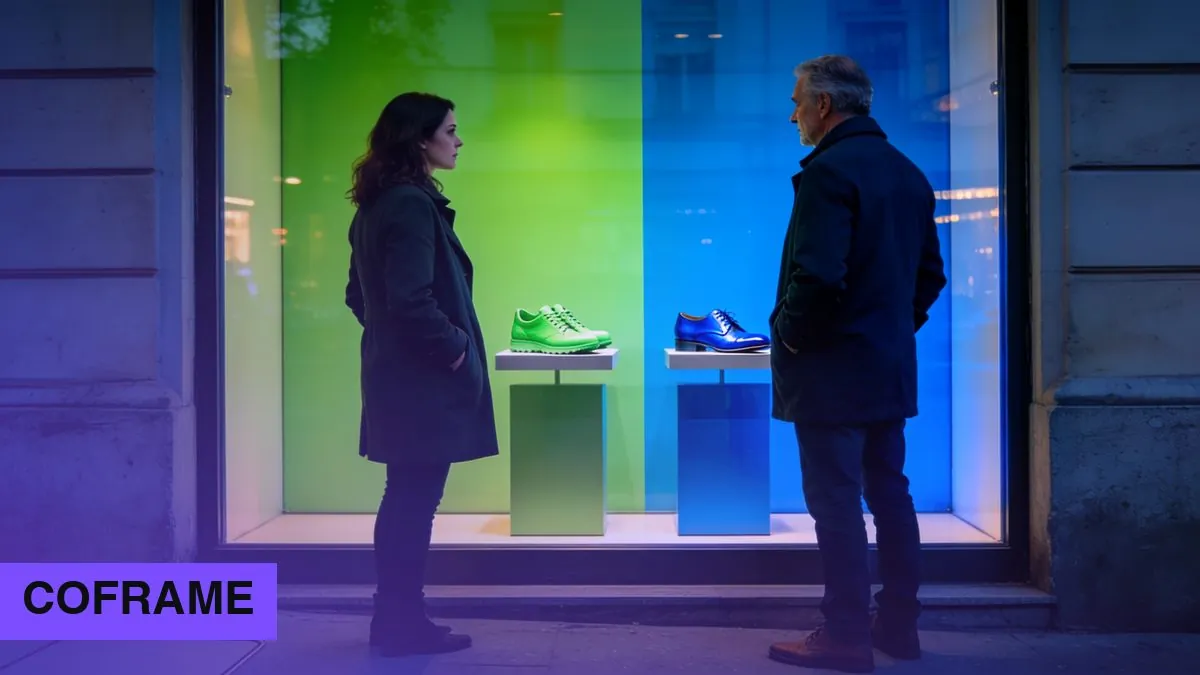
You know the drill. A homepage A/B test needs a brief, design, development, sign-off and four weeks of runtime. Variant B wins with 3% more clicks, and everyone is just glad it's over. A San Francisco startup wants to kill that process.
What Coframe announced
Per its November 9 press release, Coframe has raised $35 million in total, including a $25 million Series A co-led by Khosla Ventures and Hanabi Capital. Leaders from OpenAI, Anthropic and Google DeepMind took part, as did Nat Friedman and Antler. The essentials:
- Product: a team of AI agents (strategist, designer, engineer, QA, data scientist) generates variants of websites, landing pages and ads, tests them and deploys the winners. Apps and email are next.
- Idea: instead of one static page for everyone, each visitor sees a version tailored to them that learns from results. Coframe calls it the “living internet”.
- Customers: including Dropbox, BCG, Block, Backcountry and Sur La Table.
- Numbers (company claims): more than $300M in incremental revenue for customers, a 158% conversion lift at Dropbox, an average lift above 20%, a 39% experiment win rate.
- OpenAI: according to the release, Coframe is working with OpenAI on optimizing ChatGPT ads and their landing pages together.
Testing is solved. The brief isn't
What I find interesting: once agents build hundreds of variants in minutes, testing speed stops being an edge. The bottleneck moves upstream, into the brief. An agent only knows what you give it. Positioning, tone of voice, no-gos: if they aren't hard rules in the system, the agent optimizes for what it can measure. And that's the click.
The way I see it, your brand is no longer a page. It's a rule set. Whoever writes the rule set owns the brand. Until now that lived in a style-guide PDF nobody reads. Now it has to be machine-readable and binding.
The catch: conversion isn't everything
Performance harvests demand; brand creates it. A system that tunes every page for the next conversion can win short term and erode recognition long term if every visitor meets a slightly different brand. Then there's sign-off: every variant is an advertising claim. Who checks 400 versions for pricing and promises before they go live? And the eye-catching percentages are the vendor's own, with no baseline.
What I'd do now
- Write brand rules as a brief. One page: five things every variant may do and five it must never do. Concrete and checkable, not 'modern and fresh'.
- Set approval boundaries. What an agent may change alone (images, order, button copy) and what a human signs off (prices, claims, legal).
- Put a brand metric next to conversion. Returning visitors or direct traffic, for example. If conversion goes up while that goes down, you harvested demand instead of creating it.
Bottom line: When the website builds itself, your brief is the only part of the brand that still holds still.
Key facts
- Coframe announced $35M in total funding on November 9, 2026, including a $25M Series A co-led by Khosla Ventures and Hanabi Capital.
- Coframe's AI agents generate and test variants of websites, landing pages and ads; named customers include Dropbox, BCG and Block.
- All performance figures (over $300M incremental revenue, average conversion lift above 20%) are company claims; the release gives no pricing.
Source
Coframe (Pressemitteilung, PR Newswire): Coframe Raises $35 Million to Build the "Living Internet"