BUSINESS

Developments · · 2 min read · Source: Google DeepMind
96% on Mercedes' line: the robot story is the other 4%
Google DeepMind put its new robotics stack into a real factory: a humanoid robot sorts metal parts on Mercedes lines in Sindelfingen and Kecskemét, and gets it right 96 times out of 100. For office teams, that's more instructive than any agent demo. It shows what a good first job for AI looks like.
Researched and written with AI, to Luigi's brief, positions and editorial rules. Automatically checked against the sources. How I work →
My tool tip · AdGranola – AI meeting notesTry it free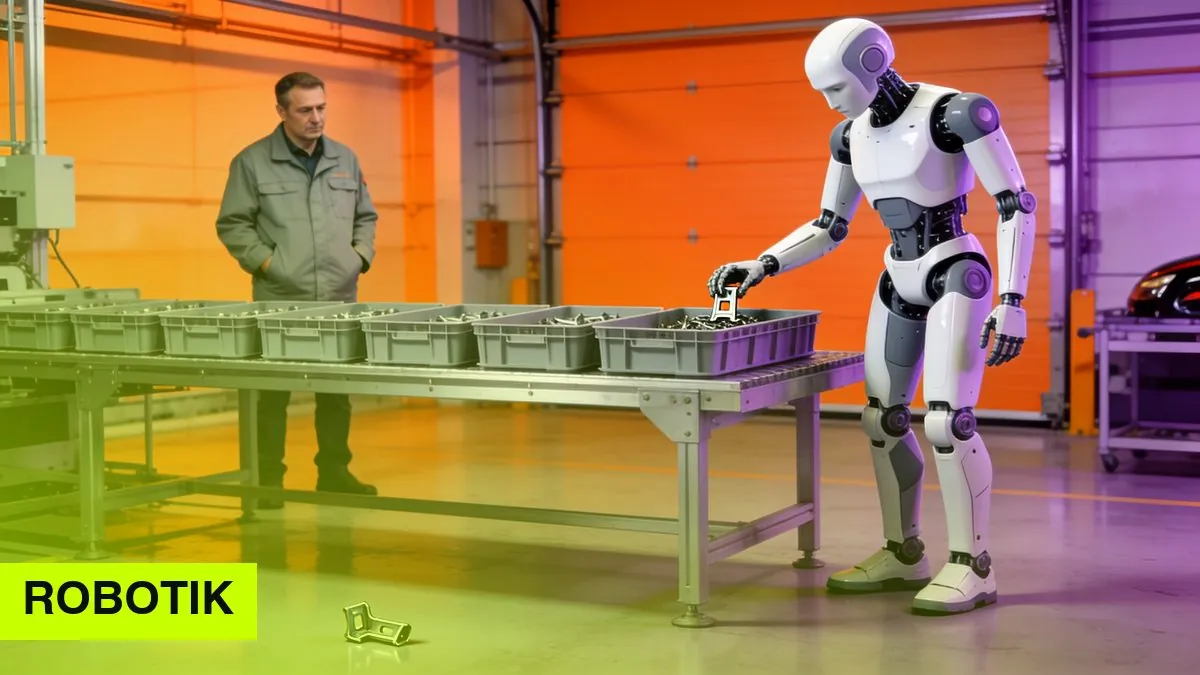
Robot news usually reads like science fiction. This doesn't. A robot stands at a line and moves metal brackets from big bins into small trays, in the order the next car needs them. That's it. Which is exactly why it's worth a look.
What happened
- Who: Google DeepMind with Gemini Robotics 2.5, a model that links vision, language and action. The hardware is Apptronik's Apollo 2 humanoid.
- Where: active Mercedes-Benz production lines in Kecskemét, Hungary, and Sindelfingen, Germany.
- What: kitting, sorting brackets from bulk bins into trays per vehicle. Success rate per DeepMind: 96%, explicitly a proof of concept.
- How: two models split the work. Gemini Robotics ER tracks the workflow, Gemini Robotics 2.5 controls arms and hands.
- Context: across 200+ tasks, DeepMind reports 30% to 100% higher success rates than the previous version and 20% to 30% faster completion. For now, the model goes to robotics partners only.
The best first AI job is boring
What I find interesting: nobody let the robot build a car. The job is tightly scoped, follows a clear sequence and ends in a result anyone can check instantly. Is the right bracket in the tray or not?
That's exactly what a first agent project in marketing should look like. My rule of thumb: one clearly scoped job that ends at a concrete decision and delivers a result someone can judge. Say: prepare a reactivation campaign, hand over the package for review. Not: "do our marketing."
The catch: who catches the 4%?
96% sounds strong. Translate it to your world. An agent that personalizes newsletter variants correctly 96% of the time sends roughly 2,000 wrong emails out of 50,000. In a plant, a wrong bracket will likely get caught on the line. In marketing, the error lands straight with the customer.
The announcement also leaves out key details: how long the pilot ran and how success was measured. It's a vendor number, not an audit. And Gemini Robotics 2.5 isn't something a mid-sized company can buy tomorrow.
So the real work isn't in the model, it's in the process around it: where's the check, who approves, where do errors go? Human in the loop doesn't mean a person standing next to the machine. It means someone knows where the 4% end up.
What I'd do now
- Find your office kitting job. Tasks with clear sorting logic: routing leads by criteria, filing assets by channel, triaging inbound requests.
- Set the acceptable error rate up front. What rate is fine, and where is the check before anything goes out?
- Build the error path. One place where wrong results land, and one person who clears it every day.
Bottom line: 96% is the headline. Whoever catches the other 4% decides whether AI works in real life.
Key facts
- Google DeepMind introduced Gemini Robotics 2.5 on Nov 10, 2026; in a proof of concept, Apptronik's Apollo 2 humanoid sorted parts on Mercedes-Benz lines in Sindelfingen and Kecskemét with a 96% success rate.
- Across more than 200 tasks, DeepMind reports 30% to 100% higher success rates and 20% to 30% faster completion than Gemini Robotics 2.
- Gemini Robotics 2.5 is rolling out to robotics partners such as Apptronik, Mercedes-Benz and Agile; DeepMind doesn't say how long the Mercedes pilot ran or how success was measured.
Source
Google DeepMind: Gemini Robotics 2.5 accelerates real-world physical intelligence


 DealTagshop Black Friday: The AI UGC plan was cheaper in January
 NewsGoogle puts ads in your AI follow-up question. The report stays blind
 NewsDeepL Aure translates tone. The best English speaker loses the floor