BUSINESS

Developments · · 2 min read · Source: Futurism
Microsoft wants AI to rewrite live speeches. Keep your master copy
A live speech has been the one format where everyone hears the same thing. A Microsoft patent filing describes how that could end: AI swaps words in real time and reshapes the speaker's mouth to match. For brands, that's not a tech trick. It's a trust problem.
Researched and written with AI, to Luigi's brief, positions and editorial rules. Automatically checked against the sources. How I work →
Related tool · AdRunable – AI agent for finished workTry it free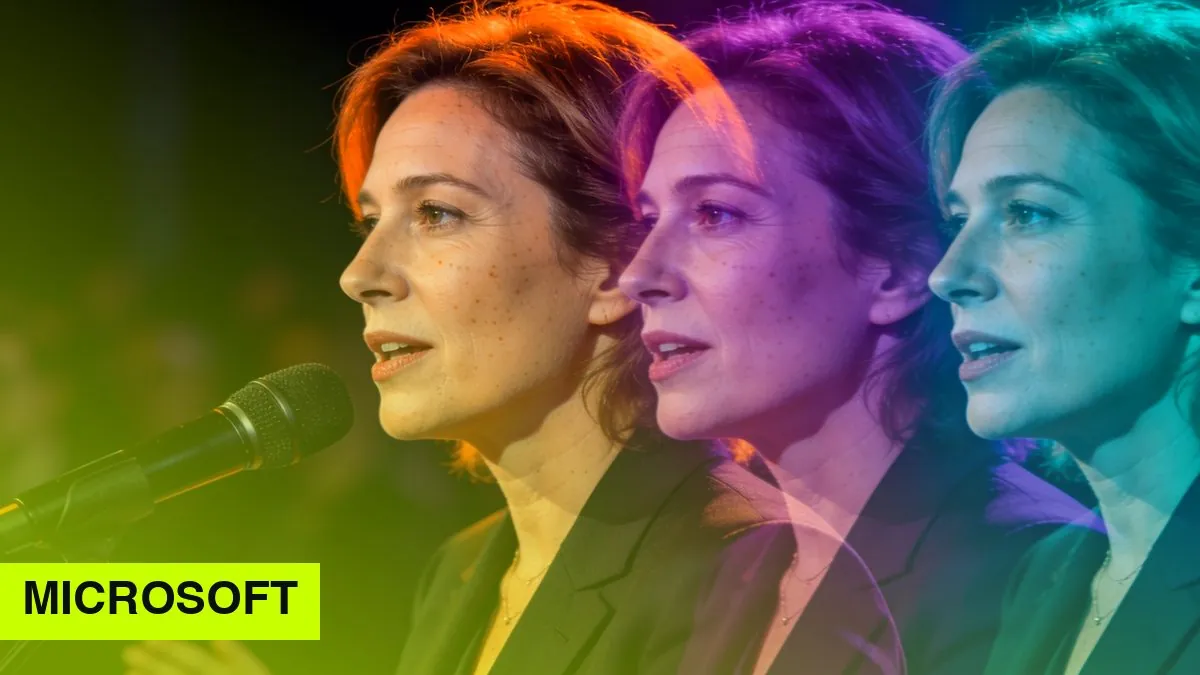
Picture your CEO giving the keynote at your annual conference. The room hears version A. A viewer on the livestream sees a slightly different talk: cleaner, no "ums", a different word at the one sensitive moment. The next day a reporter asks: so what did she actually say?
That's roughly what a Microsoft patent filing describes, as reported by Futurism.
What the filing describes
- The mechanism: AI agents spot certain words in live video, replace or remove them, and edit the speaker's mouth and face so picture and sound still match. The moments just before and after are smoothed too.
- The controls: set parameters or user profiles. Replacement words can even come from an internet search, according to the description.
- The use cases: translation into the viewer's language, cutting filler words like "um" and "ah", smoothing stutters, replacing colloquial terms or words deemed offensive. Lectures, presentations, award shows and live sports are all mentioned.
- The safeguard: the unedited original may be stored as "ground truth".
To be clear: this is a patent filing, not a product. Microsoft hasn't announced one and didn't respond to Futurism's request for comment.
The keynote becomes a targeted ad
Live translation is the obvious use case, and it's genuinely great. The real break is somewhere else. Once a speech can adapt to the viewer's profile, a brand's last shared format gets personalized. The keynote starts working like a targeted ad.
For performance people, that sounds tempting. For the brand, it's dangerous. My rule: trust is a brand's most valuable asset. That's why, as CMO at burgerme, I deliberately kept AI-generated content out of the main brand's communication. A talk where everyone hears something different isn't a talk anymore. It's a campaign. And in a crisis, only one sentence counts: the one that was actually said.
The catch: the original becomes evidence
Microsoft clearly sees the abuse risk, otherwise there'd be no "ground truth" archive. For companies, that means the unedited recording becomes the most important document of any speech. Without it, you can't prove anything when it matters.
In the EU there's a legal layer on top. Since August 2, 2026, Article 50 of the AI Act applies: if you use AI to generate or manipulate image, audio or video that counts as a deep fake, you have to disclose it. Dropping a filler word is harmless. Swapping a word in your CEO's mouth is not.
What I'd do now
- Write a video-AI rule. What can be edited automatically in executive appearances (translation, filler words), and what never (content, statements)? One page, signed off by leadership.
- Archive the originals. Store every keynote and statement uncut, with a date. That's your ground truth, whatever tool you end up using.
- Prepare a label. Draft a standard disclosure for AI-edited video before the first tool needs it.
Bottom line: When everyone can hear a different version of your CEO, the original is the only thing your brand still owns.
Key facts
- A Microsoft patent filing describes AI that replaces or removes words in live video and edits the speaker's mouth and face to match, driven by set parameters or user profiles.
- Use cases named include translation, removing filler words and stutters, and replacing colloquial or offensive words; the original footage may be stored as "ground truth".
- Microsoft has not announced a product; in the EU, deployers must disclose deep fakes under Article 50(4) of the AI Act, which applies from August 2, 2026.
Source
Futurism: Microsoft Patents an AI That Can Literally Put Words in People's Mouths in Real Time
More sources
- Patentlyze – Zusammenfassung der Patentschrift, von Futurism verlinkt
- AI Act, Artikel 50 – Art. 50 Abs. 4: Betreiber müssen Deepfakes offenlegen; gilt laut Art. 113 ab 2.8.2026
 Dealneuroflash's Black Friday: a real 25% off, minus the code