 BUSINESS

Illustration
Developments4 min read
Study: ETH's AI balances a 5-tonne loader, and a laptop is enough
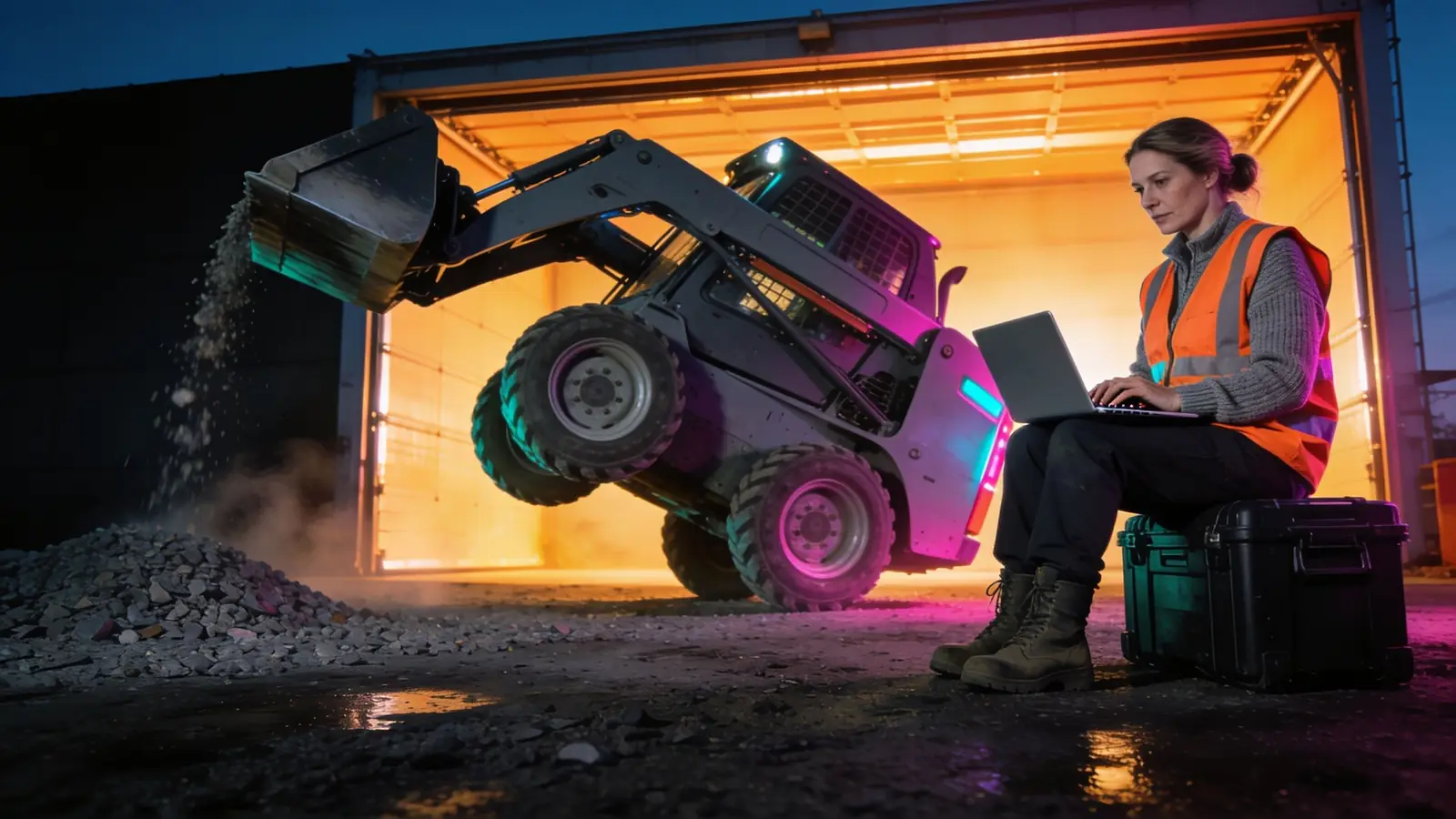
An AI skid steer loader from ETH Zurich: a 5-tonne John Deere machine balances on two wheels, crosses bumps and lands softly, controlled by a standard laptop with no GPU. Per the Science Robotics study (November 11, 2026), 107 minutes of real driving data, a tape measure and truck scales were enough, with no manufacturer model.
Key facts
- ETH Zurich, Blue River Technology, Gravis Robotics and Intel published the study in Science Robotics on November 11, 2026; it has been on arXiv since November 13 (2611.18365).
- The controller was trained only in simulation; the hydraulics model learned from 107 minutes of real driving data, and a laptop runs a John Deere 332G over its CAN bus.
- Swing-up onto two wheels: 11 of 11 and 12 of 12 trials in the trained range, 11 of 14 (78.6%) outside it; classic MPC could not do the swing-up or the soft landing.
Researched and written with AI, to Luigi's brief, positions and editorial rules. Automatically checked against the sources. How I work →
A five-tonne skid-steer loader rocks back and forth, tips forward and stays up on its two front wheels. Then it drives over bumps like that, spins on the spot and sets itself down gently. Nobody is on the joystick. The video will travel. The real news is in the methods section.
What the ETH study shows
Researchers at ETH Zurich's Robotic Systems Lab published the work with Blue River Technology (Santa Clara), Gravis Robotics AG (Opfikon, Switzerland) and Intel's Intelligent Systems Lab in Science Robotics on November 11, 2026; the authors' version has been on arXiv since November 13 (2611.18365). The machine: a John Deere 332G with a hydraulic drivetrain and an operating weight of about 5 tonnes. According to the authors, these maneuvers have previously been done only by a handful of elite operators in official world-record runs.
- Training used reinforcement learning entirely in simulation, with no expert demonstrations and no preexisting model of the machine.
- A small neural network learned how the hydraulics behave from 107 minutes of real driving data: about 1.5 hours of randomized commands plus 20 minutes recorded while balancing.
- Dimensions came from a tape measure, mass and center of mass from truck scales.
- Control runs over the machine's CAN bus from a standard Linux laptop (Intel Core i7, 16 GB RAM, no GPU). Two motion sensors were retrofitted.
The numbers from Table 1: with the arm at 28 degrees the swing-up worked 11 of 11 times, at 31 degrees 12 of 12. At 34 degrees, outside the 29-to-31-degree training range, it was 11 of 14 (78.6%), with the bucket touching the ground three times. The loader also drove over 75-centimeter undulations on two wheels, despite training only on flat ground.
Why the retrofit is the story
Sounds like a circus act. It isn't. To me, the stunt is the demo and the method is the product: an existing hydraulic machine, no manufacturer model, under two hours of data, one laptop. The authors show it isn't a one-off: in the appendix, the same procedure worked on a 100-kilogram electric vehicle, using 5.5 minutes of driving data.
The comparison with classic model predictive control (MPC) is what I find most telling. On balancing, both were level, and MPC even oscillated less at high spin rates. But the swing-up, uneven ground and the soft landing only worked with the learned controller. That is exactly where ground contacts keep changing. The authors themselves cite productivity, cost and workforce shortages as the reason this matters. For construction, farming and logistics, that is the point: if you can retrofit the fleet you already own, you don't have to wait for the next machine generation.
My rule from marketing applies here too: AI doesn't fix broken ways of working. The leverage is the unglamorous work up front. Here, that means clean driving data, a tape measure and a scale. And every skill is its own tightly scoped job (swing up, stabilize, drive, land) that can be checked on its own. That's also how I'd scope a first AI agent project that earns its autonomy.
The catch
- One machine, one test site, with a wheelie bar on the back and wheels on the bucket for protection.
- Switching between skills follows hand-written rules. The controller doesn't use cameras or LiDAR yet.
- Stunts are not production work. The authors list self-loading onto a truck without ramps only as a possible application.
- The paper stresses it is research only and no endorsement by Blue River Technology or John Deere to attempt these maneuvers.
How long the road from demo to daily work can be is also clear from the robot deployment at Mercedes in Sindelfingen, and why simulation alone rarely suffices from Apple HALO versus Microagi.
What I would do now
- If you run construction, farm or warehouse machines: check which ones already expose their signals over the CAN bus. That's the entry ticket for any retrofit.
- Ask automation vendors how much data and what process they need per machine, not for the demo reel.
- Scope the first use case tightly: one maneuver, one site, one person with a kill switch. How I scope a first use case for software is in my guide to AI agents for marketing.
Bottom lineFive tonnes on two wheels sells the video. The 107 minutes of data and the laptop sell the business model.
Got AI news? Submit news →
FAQ
What did ETH Zurich do with the skid steer loader?
An AI trained in simulation makes a 5-tonne John Deere 332G balance on two wheels, drive, spin and land softly, controlled from a laptop over the CAN bus.
Does the method need a model from the manufacturer?
No. Per the study, 107 minutes of real driving data trained a learned hydraulics model; dimensions came from a tape measure and mass from truck scales.
Is this used on construction sites yet?
No. It is research on one machine at a test site with safety bars; the authors mention uses like self-loading onto trucks only as possibilities.
Source
More sources
- Science Robotics – Veröffentlicht 11.11.2026, begutachtete Fassung
- Projektseite mit Videos (RSL ETH Zürich) – Videos der Manöver
- Dryad (Daten und Code zu den Abbildungen) – Datensätze und Code zur Erzeugung aller Abbildungen, laut Paper öffentlich


 DealHiggsfield Black Friday: the 45% is measured against a new price
 NewsSiri AI daily limits: everyone can buy more AI except the EU
 NewsStudy: ETH's AI balances a 5-tonne loader, and a laptop is enough